

#16


INTRODUCTION
We will keep the intro as brief as our break was supposed to be and let the pieces be as long as it ended up being.
Hi. Happy New Year? Happy first edition of 2026 to us at least. We start with Vanij Choksi, who inquires into the predetermined logic of cinema; Varun Oak-Bhakay laments the great series to mid films trajectory ft. Peaky Blinders: The Immortal Man; Prakhar comes with a plea for The Secret Agent amidst the frustratingly never-ending Dhurandhar frenzy and Soham Badola, our guest contributor offers personal reflections on Lynchian cinema.
Shall we?
1. This Delicate Dance With Disaster
VANIJ CHOKSI
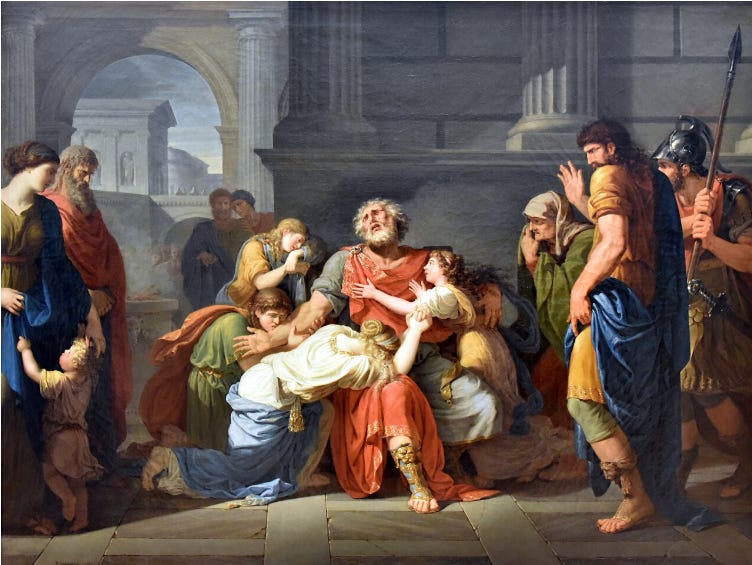
There is a certain type of role-playing attached to the inherent characteristics of film-watching. Namely, of playing God. A forceful participation in the heretic act of assuming all-seeing, all-knowing divinity, of surveying with intent and foreknowledge beyond the possible comprehension of a subject. The obvious reason for this notion is the apocryphal idea that cinema, by its very nature of artistic construction, behaves as a predetermined, foreordained machine functioning on a creatorial logic, exemplifying an exact beginning, middle, and end. It describes non-revisionist episodes with inescapable accuracy, persecuting its unknowing inhabitants fated for cold, frozen singularity stored in hard drives or corrugated film cans. As such, we have almost grown a clairvoyant preconception of a film’s outcome — the good guy wins, the guy gets the girl, the protagonist’s lover dies; events that usurp a latent conviction in its eventuality, satisfactorily surprising us. True for all films is our witnessing of a creatorial intent achieve fruition, like a well-known prophecy attaining fulfilment by divine providence — something we seemingly have no control over. What elasticity of responsibility is permitted to us then, let alone the characters in a film who we want to, or perhaps illusorily identify as conscious actors of free will?
In his notes prefacing Robert Fagles’ translation of Oedipus The King — itself a biblical inquiry into anxieties over predeterminism — Bernard Knox writes of the theatre as such:
“[...] engagement of the audience proceeds from an identification with the figures on stage, and this is not possible if we are made to feel that the action of the characters is not free, not effective. We expect to be made to feel that there is a meaningful relation between the hero’s action and his suffering, and this is possible only if that action is free, so that he is responsible for the consequences.”
This causal relation between action and consequence, so rife with immediacy in the theatre, renders the elasticity of our identification of free will expansive, for the theatre’s methodology veers more toward the performative. Although its creatorial outcome is similarly determined, its performative methodology accommodates the present — for chance and the intervention of human free will to alter, ever so slightly, its literal articulation. In the cinema – drawn in genesis at least from concepts of the theatre – the only permissible “presence” is of the audience, though deterministically speaking, it remains hopelessly ineffective. If the only variable of the cinema is rendered inert, lost somewhere to elements cosmically planned in advance, what hope do we have in identifying the actions of its players as free or effective, as human or alive? In the progression of the cinematic plot, the possibility of revelation in the repetitive actions of any given character pales in comparison to the grander trajectory of the storyline — a foreordained rendezvous with a denouement set in their stars. The people we are given to identify with turn out to be nothing but cogs in a machine, trapped, unable to assert themselves and bound sadistically for our spectatorial pleasure. All qualities of their existence discernibly indicate falsities, only fed to us as truth. By this metric, the argument at hand potentially includes a risky supposition: that the theatre theoretically bears less of a disidentification policy than the unsparing exactitude of cinema.
Cinema has, since its beginning, quite blatantly cloaked a deceptive attitude. From its advent in fairgrounds to its present form, cinema has always promised an acceptable reality that aims deviously at our sensorial experience of the world around us. It feels alive, breathing, it moves in the way we are accustomed to registering the flow of our time. But this is fundamentally untrue. It starts with its most popularly forgiven miscreance: motion. The now unconscious act of creating motion from a series of still images conflates the cinematic invention with the recording of natural time. Do personal histories exist somewhere as a series of recurring still moments from our progression through time in the way cinema suggests that they do? The illusion of motion is perhaps cinema’s original sin, a radical yet blasphemous intervention whose suffering is conferred with disregard to cinema’s many inhabitants — their sterile ache only visible upon intense scrutiny. In engaging with the suffering of these pseudo-people, though their physicality is insinuated as real, they cannot be alive, for living endlessly under the surveillance of rigid determinism means they possess no future. They are ghosts, blistering reanimations of a time and people bygone; burning into light, bleeding into colour, freezing into time — the ache of conjuring their cosmos in a coffee cup. Born into a graveyard, destined for a tomb prior to their conception, the anxieties of cinema parallel ours, not just in dramatic subject matter but more horrifically in the very fabric of its nature; that every step taken towards a perceived ideal of progress and away from disaster leads us to a pointedly X-marked moment of doom concealing our future and sealing our fate.
The whole culture of filmmaking and film-watching is apparently thrown into precarious suspension; unseen exertions exacerbating unconscious anxieties. The concept of realism in this art form then exists as obsequiously as a horse to a whip. Yet somehow, there is still some dull consolation that cinema is perhaps deeply relatable, not only because of its storytelling but also because of its default alignment with our primary fears, that its gospelic truths work precisely as a virtue of antinomy. As an audience member, often finding out what you secretly know is what actually happens, yet accepting it with surprise and shock reaffirms our desire for a meaningful pattern, for a designed story to hold us, dovetailing with our defiant assertion to interpret it freely. As Knox puts this argument’s philosophical equivalent, “We want both the freedom of our will and the assurance of order and meaning; we want to eat our cake and have it too.” Imagine rewatching a film knowing exactly what happens. Here, we volunteer a suspension of certainty, secretly hoping for a different exit – “No, don’t go there”, “say something else”, “do that instead” – imagining alternate strands, weighing alternative courses of action, ultimately arriving with grace to the outcome we are allowed, crucially of our own accord. Imagine further, to those filmmakers whose work is branded as subversive; genre subversion occurs by playing on or reinventing its determinism, by revising elements to form its own kind of determinism that departs from key genre beats that define itself — an excursion in free will as an afterthought of the acknowledgement of determinism of some form. And coming, at long last, back to the spirits of cinema, like realism, a horse, bound, blinded, whipped — crucified by another’s will. Their fate is sealed, but is their suffering real? If they suffer from the primary plague that is the nature of cinema, that we too fear in “real” life in some way or another, does that make them, paradoxically, just like us?
“The only way to believe in the pattern and the freedom at once is not as a logical proposition but as a mystery; the medium of exploration is not philosophy but religion—or art [...] Only a mood of religious humility or a work of art can hold in precarious coexistence the irreconcilable concepts.”,
writes Knox in relation to the questions posed in that Sophoclean play. The tense meta-narrative of Oedipus as a character bound by the fate of the text, as well as, in the play’s subject matter, a man at the mercy of a predetermined cosmic fate, exemplifies the paradoxical realism of artistic invention. The irreconcilable question posed in the dramatic text of Oedipus The King probably has relevance here in thinking that Oedipus, prophecised to slay his father and rear children with his mother, has perhaps, in some remote mental register, always known his fate prior to its devastating revelation but willingly chooses to ignore it (as an exercise, think of it as Oedipus even remotely knowing he’s a character in the play). The first freedom you exert is flinging yourself into ignorance of the design with reckless abandon — accepting its existence by choosing to forget it and be surprised by it, vainly asserting your free will. You almost have a latent belief in its outcome, yet remain wholly oblivious to its inevitability. You almost timidly attempt to protect yourself from the “wrath” of the design by wanting to experience happiness, however illusory, fragile, or bleak. Just like Oedipus, the noble King, the pious devotee of oracles and prophecy only hypocritically, heretically defying it when it initially carries the word that threatens his security, his happiness — his kingdom, children, and wife. He is, after all, a man, like any of us, afraid to lose what is his. We want to experience these happinesses regardless of the horrifying looming implications of the design. It is perhaps an innate trait all humans are cursed/endowed with (depending on how you look at it) to preserve our security; like postponing dreadful tasks, wishing it as having no influence upon us, only confronting it when we must, inexperienced and caught totally, hopelessly off-guard by what we have always known. Though in doing so, we have also accepted the bargain that the light experienced in temporary ignorance is completely worth its delayed, violent confrontation. We ultimately treat this delicate dance with disaster in vain, perhaps, as we should.
2.Peaky Blinders: The Immortal Man
VARUN OAK BHAKAY
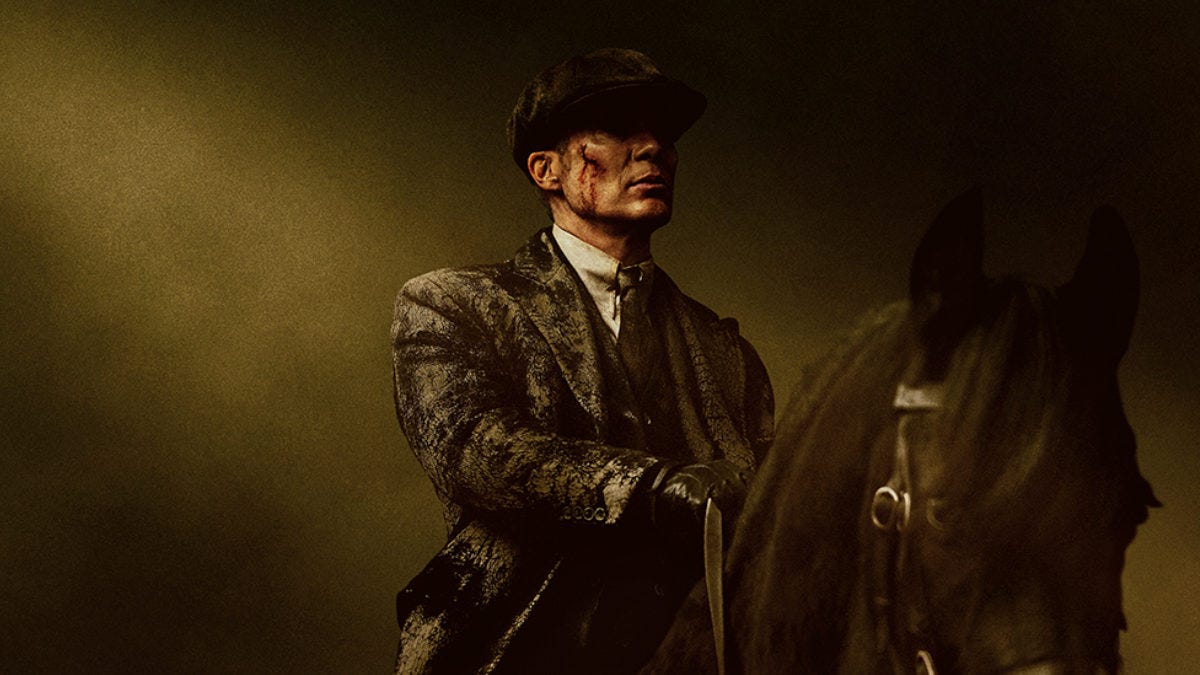
Full disclosure: I haven’t been a Peaky Blinders fan since the culmination of the third series. The moment Adrien Brody showed up, toothpick poking out of his mouth, which also housed the laziest excuse for an Italian drawl (a high bar that his ludicrous Hungarian accent in The Brutalist [Brady Corbet, 2024] almost surpassed), I noped out of the show. What had been a gripping, grimy drama with the odd off-key moment had turned into a full-blown showcase of hysterical histrionics. In the four years since the show closed, its chief personnel have moved on: Cillian Murphy has been minted with an Academy Award and then turned to producing and starring in fierce scaled-down dramas, Natasha O’Keeffe has switched between indie films and prominent small-screen roles, Tom Hardy has fronted franchise blockbusters and tentpole streaming shows, and Sophie Rundle has headlined two major shows. Nobody, however, has been as busy as creator Steven Knight: SAS Rogue Heroes opened months after the sixth series of Peaky Blinders, followed by adaptations of Charles Dickens’ classic Great Expectations and Anthony Doerr’s Pulitzer-plumed All the Light We Cannot See, a globetrotting miniseries starring Elizabeth Moss, another set in the more confined space of 1980s Birmingham, a London-set Victorian boxing drama, and the curiously beer-starved House of Guinness, a “prestige drama” about the Dublin-based family that brew a decent stout people around the world (barring the government of the United States) would term “black gold”.
Now I know that reads like a shopping list, especially the bit about Knight’s work, but it frames the atmosphere in which Peaky Blinders: The Immortal Man (yay for stupid titles from the people at Netflix Original Films) has been made, for here is a film that is entirely in service of the online image of the show. Knight’s commitment to his work is beyond reproach but in this film is a problem that had already surfaced with the source material in 2017, and was somewhat evident even in SAS:RH and HoG.
The Second World War is in full sway and the Nazis are busy printing counterfeit currency to disrupt the British economy and wrest control of the action on the Western Front. They find an ally in John Beckett (Tim Roth), another of those British gentlemen in the mould of protagonist Tommy Shelby’s old mate Oswald Mosley. Beckett is to bring in the Blinders, now controlled by Duke Shelby (Barry Keoghan), and use organised crime to inject the notes into the system.
Duke is irrational and about as level-headed as most other Keoghan characters, and his father Tommy (Murphy) has long left the life of a gangster/politician for that of a loner on a rural estate. Into this rather uninspired landscape, Knight injects wooly mysticism though Rebecca Ferguson’s Gypsy clairvoyant and brings back a raft of old characters, the notable exception being the mercurial Arthur Shelby (Paul Anderson).
Beckett and Duke join forces, and it falls to Tommy, who keeps seeing dead people all over the place as he puts pen to paper rather than gunbarrel to skulls through his greying days. It’s a relief to see Murphy own the character’s dull grief — his abilities as a performer give the impoverished material a far better deal than it deserves, and unlike the other major levers of the film, he feels like he belongs.
The trouble with much else about The Immortal Man is how hemmed in it is by its erstwhile television form: at no point does it transcend the boxy shape of the screen. It never goes truly wide. Its ambitions remain low-stakes too, with the very lopsided edge of cozying up to the Nazis. Throw in the Ferguson character, and this is really a load of waffle. The characters look familiar but have absolutely nothing to do save a showboating moment for Stephen Graham’s Stagg that sets up the climax. The new ones – Beckett and Duke – bring little to the table, though I’m happy to admit that Roth is the kind of actor who makes even dull cutouts like Beckett seem interesting. Keoghan, however, struggles to play the sort of psychotic creature of violence he actually did a pretty handy job with in last month’s Crime 101 [Bart Layton].
What prompts the makers of successful television shows to turn to filmmaking?
Knight isn’t the first to do it, and he will not be the last, but in Julian Fellowes’ three Downton Abbey films, surely he could see how terrible such additions to perfectly satisfactory endings could be? The Immortal Man is hobbled by its need to serve a show whose primary cast, Murphy aside, was mostly dealt with in the final series, so Knight resorts to bumping off what is left of the cast to up the stakes, only there’s nothing left on the table for either him or the audience to take away by the end.
3. I Sat Through Dhurandhar, Now Will You Watch The Secret Agent, Please?
PRAKHAR


Before getting to the actual reason I invite you to watch The Secret Agent, let me state the most lucrative one: Wagner Moura is magnetic as Marcelo/Armando, a technology specialist under the suspicious eye of the regime and its capitalistic friends for refusal to comply. His Cannes-winning screen presence demands your attention, and once he has it, the slow-burn political thriller’s two-hour-forty-one-minute runtime is barely noticeable, immersing you in the military-governed Brazil of the late 70s. More than anything, Kleber Mendonça Filho, the director and writer of the film, is interested in creating an atmospheric tale of what it is like to live under the frustrating, paranoia-inducing scrutiny of citizens with suspended free will in a country crippled by authority. The Secret Agent released in the Indian theatres in February attaining meagre screen space amidst the still continuing Dhurandhar frenzy. To imagine these two antithetical docu-fictional treatments of a nation’s collective trauma playing in screens side by side is poetic to me. Dare I call it the universe’s feeble attempt at balance? It sure will help me sleep better at night. Though I know the truth. The former will whimper on a meekly white sheet screen at an intimate screening of some film club while the latter drives a country crazy.
For those who need markers of acclaim, The Secret Agent was the most decorated film at Cannes 2025, with four awards including the Best Director (Prix de la mise en scène). It is a melancholic reflection on the death of democracy and the dictatorship that rises in its wake. This is embodied in the opening scene, when Armando , on his way to Recife to adopt a new identity – Marcelo – and reunite with his son, stops at a gas station in the middle of nowhere. He is met with a rotting body, a desensitised station owner, and unbothered policemen in blood stained uniform more interested in his business than their duty. One immediately absorbs the sad state of affairs and progressively grows afraid for Armando as the plot develops. Filho adopts a multi-storyline, multi part structure to create fragmentation and anticipation, allowing the viewer to piece together the story: an ex-researcher on the run, a pair of hitmen on the trail, and a university student in the future listening to tapes that hold whatever truth survives. He visualises these with tinted, memory-soaked, slow-burn imagery, leaving enough room for thinking.
Why drag the mass entertainer Dhurandhar into this conversation about supposed ‘high art’?
A few years back, I went to Czechia on a cultural exchange. The volunteering programme invited English-speaking youth from around the world to lead Global Week in Czech schools. The idea was to expose the students to different cultures and, while at it, improve their English. We worked in groups of five to six, each member from a different country, travelling around Czechia to a new school each week. One of the first fellow volunteers I became friends with was J from Brazil. As we learnt more about each other and the countries we came from, J concluded India and Brazil aren’t that different. Back then, I was not particularly interested in geopolitics, and I have never been an MUN brat. Naturally, I hadn’t viewed India in light of comparison beyond Pakistan, China, and occasionally the US as the embodiment of all things West. However, J was right. The memory of his accented emphasis on “rich cultural heritage”, “flavourful, spicy food”, “large landmass”, “requirement of street smartness as a survival prerequisite”, “loud, vivacious festivals”, “religiosity for a sport”, “unmissable poverty”, “undeniably corrupt governments” rushed back to me as on his drive, Armando notices amusing one-liners written on the backs of trucks. Indian trucks are an aesthetic in themselves, and their quirky phrases a genre of poetry in their own right. It is delightful to see the joy of reading Portuguese counterparts of “Humari chalti hai, buri nazar wale ki jalti hai” in Armando’s smile. Almost as unnerving as seeing him navigate militarised dictatorship in Brazil of the 70s and, in it, as a viewer finding traces of India’s present painted in bold, flashy strokes.
A sub plot of interest here is that of the hairy leg. In the film it shows up first in the stomach of a washed up shark, a gruesome scene indicating dumping of victim’s undocumented bodies in the sea and then as it transforms into an urban legend. To avoid censorship, the newspapers of Recife at the time adapted a codified metaphor, a hairy leg that attacked the vulnerable to report about rampant police brutality and targeting of homosexuals, communists, those who defied control or anyone qualifying as the ‘enemy’ such as intellectuals like Armado. The attacks he receives are systemic, designed to corner one to submission or death. Crafted to ensure whatever truth may be, the narrative must follow the dictator’s script. When he refuses to build electrical machinery for a pro-military company, his research is defunded and the team is disbanded in revenge. Driven out of a job and tackled down by a smear campaign alleging corruption, he is rendered a refugee in his own country. What does it mean to be unwelcomed in a place you belong? Filho supplements the narrative with delicate moments looking for an answer. Tensions fueled by this very question are encapsulated in an effective confrontation scene where the power and electricity industrialist Henrique Ghirotti and his successor son sit across Armando and his educator wife Fatima as the Right comes face to face with the Left. The interaction heavy with the disdain Ghirotti carries for the free thinking liberals he labels ‘communists’ sitting in front of him soon turns ugly owing to his inability to treat them as individuals deserving of respect. Isn’t it the story of our times? Any inclinations to the Right is rounded up to fascism and to the Left becomes communism. Those incapable of a decent reflection or simply ignorant find themselves enjoying the luxury of existing above/beyond/outside this spectrum. “I don’t concern myself with politics”, gang. For you specifically, let’s turn films into a litmus test for political ideologies, shall we? It is simpler than you’d imagine. All you have to do is ask yourself ‘why’ for all that a film makes you feel - entertained, bored, sad, angry and the whole range.
The hairy leg makes one think of many codes the media adopts and the code it can be whether in protest or for propaganda. What better example than the machismo of Dhurandhar now that the second part is hogging screens and attempting to colour our collective perceptions orange? When I ask why, it appears to be designed to celebrate a state brave enough to enter and obliterate enemy territory turning a blind eye to what history screams. A nation state obsessed with the violent take down of enemies without, also creates them within to maintain its “protector” facade. The Secret Agent shows you how it is done. Dhurandhar is a sign it might be coming our way.
GUEST CONTRIBUTION
4. Morning Coffee and Some Thoughts on David Lynch
SOHAM BADOLA
It’s 9:30 a.m., and the smell of coffee has begun to hug everything in the room. I switch off the stove, pour myself a cup and sit on the floor in the living room, where the sun cuts through the curtain and a sliver of light falls on my face. The steam rises from the cup, disappearing midway before touching the ceiling. My head is still groggy, and the excitement of the first sip makes me smile. It touches my tongue and falls into the pit of my stomach, gently waking me up, one moment at a time. Emotions and aches float around like primordial beings in the jelly-like recesses of my mind. Amidst anxieties, desires and the sweet morning sun, an image begins to form, the image of a person. I close my eyes, and am reminded of everything I have to do today. The coffee has made me a person again. A person with things to do, a name. A person with a face.
For me, the cinema of David Lynch is an attempt to express this state, right before consciousness asserts itself. It is built upon the desire to know and feel what exactly is floating in that secret river beyond thought, from which the child emerges, horrified by its own reflection.
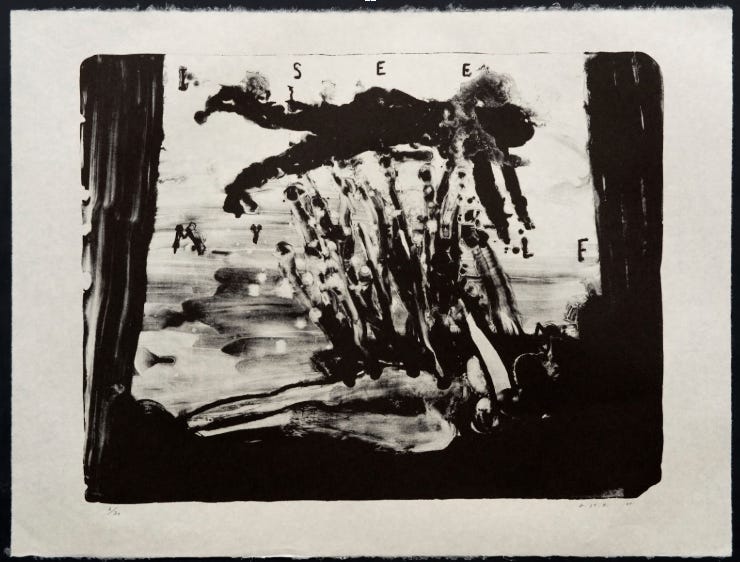
I find Lynch’s films to be a direct descendant of his practice as a painter. He uses images, characters, audio and props as a painter applies paint to the canvas. Not interested in telling a convincing story rooted in traditional narrative, he explores his inner workings through image and sound by creating a fractured reality, where familiarity and strangeness collide, creating a fundamental mistrust of everything we see. It’s a series of moods until the curtains close and we arrive at the end.
Lynch is notorious for not explaining his art, arguing that “the film is the thing”, and explanations can only limit the experience of the viewer. To “understand” Lynch’s oeuvre, we have to look at the man himself. Being brought up in the optimistic, industrial Americana of the 1950s by loving parents, Lynch was highly receptive towards the dualities of his times: the happy family contrasting with the stark smoke engulfing the country. This duality has always existed in all of his work: a screech right under the music or a severed, ant covered ear in the garden of a bright, cheerful neighbourhood.
Lynch has even managed to bring the ambiguity of painting to his cinematic frames. He creates misalignment by bending the rules of reality in a manner which accumulates, creating a series of moods which accompany the literal image. He feeds the conscious and unconscious mind at once. A flickering light, or a smile which is slightly too eager. And in that slight misalignment, the world begins to feel staged — not artificially, but intentionally, like a memory trying to reconstruct itself. This is from where the strangeness erupts and permeates into every aspect of the film. What’s terrifying is not this eruption, but how gently it sits beside the ordinary and how easily it is absorbed.
None of what we see in Lynch’s films is real; it’s just what’s happening.
I distinctly remember my first viewing of Eraserhead (1977). I was in art school and was wrestling with the idea of an experimental form of filmmaking that emerges from my own self rather than being derived from a pantheon of artists. Around me, I saw a mish-mash of unfinished ideas, trying to be like Maya Deren or Stan Brakhage, presented as avant-garde when in actuality they were just lousy attempts to escape effort by art students. I stumbled upon Eraserhead, and in the words of Lynch, upon discovering painting as an art form - “A bomb went off in my head”. It seemed to be operating on a plane of its own and felt like a glimpse into a fully formed world of strangeness. This strangeness to me had no context at the time, yet it enveloped my senses. I thought about the film for weeks, trying to study it, but the moment I tried to grasp it with a reading of surrealism or recurring leitmotifs, it felt like I was moving away from the point. There was a natural airiness to this film, and the moment I tried to read into it, it was like shutting the windows. Lynch called Eraserhead his “most spiritual film” and provided no further explanations. I think that is enough. It is a spiritual film, and that’s that. It is so distinctly him that they had to coin a word to describe it. Watching Eraserhead gave me the permission to look at my own private anxieties, moods and patterns, and that act of watching brought me closer to myself.
I look at my face in the mirror. I look at my eyes, and they look at me. The curtain dances as a jolt of wind arrives in the room. It touches my hair and then disappears into itself. I keep the cup of coffee in the sink and get in the bathroom to brush my teeth. A medium blob of toothpaste on plastic bristles. I put it in my mouth and go through circular motions. I spit out foamy blood. I wonder what toothpaste and blood would taste like, mixed together. I try to ignore the blood and carry on brushing. I spit some more blood. This time, the ratio of blood to toothpaste is more. It’s redder. I rinse my mouth and look at my teeth. My bottom canine is bleeding at the gum. I suck in the blood and swallow it. Mixed with the toothpaste residue, it feels like eating a chewing gum with a bloody centre. I touch my teeth and tug it gently. It comes off and lands on the sink, going into the pipe before I can catch it. I look at the void it has left in my mouth. A dented cavity oozing blood. I put some cotton in it and take a shower. I get dressed and go to work. All day, I think about my tooth. I miss it so much.
Picks of the Month
A short list of the writers each choosing the best film/show they’ve watched in the preceding month
Vanij: Akitsu Springs (dir. Yoshishige Yoshida, 1962) & The Green Ray (dir. Eric Rohmer, 1986)
Prakhar: Princess Mononoke (dir. Hayao Miyazaki, 1997)
Varun: Project Hail Mary (dir. Phil Lord and Christopher Miller, 2026)
Call for Guest Contributors
Cut, And Print! emerged from the shared enthusiasm of a bunch of young film critics interested extending their habit of “living and breathing” cinema to “writing and publishing” about it. While our core team contributes to the Newsletter regularly, we are always on the lookout for people to join our tribe.
If you’re interested in contributing you can -